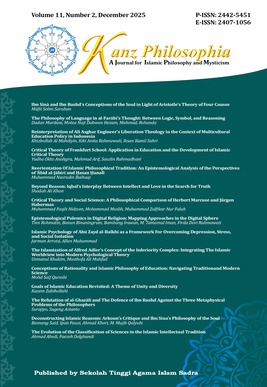
DECONSTRUCTING ISLAMIC REASONS
ARKOUN’S CRITIQUE AND IBN SINA’S PHILOSOPHY OF THE SOUL
DOI:
https://doi.org/10.20871/kpjipm.v11i2.468Keywords:
Hermeneutics, Ibn Sīnā, Islamic Reasoning, Mohammed Arkoun, Philosophy of the SoulAbstract
Amid ongoing debates on the critical re-evaluation of the Islamic intellectual tradition, this paper directly addresses the need for a deconstructive approach by analyzing Ibn Sīnā’s philosophy of the soul through Mohammed Arkoun’s hermeneutics to expose the power-knowledge nexus in its epistemological foundations. The research pursues three objectives: first, to dissect Ibn Sīnā’s conception of the soul critically; second, to evaluate Arkoun’s critique of religious reason—particularly his concept of l’impensé—in the deconstruction of metaphysical assumptions; and third, to formulate a methodological synthesis that bridges philosophical-textual analysis with ideological critique. Utilizing philosophical-critical hermeneutics, the study proceeds through three stages: a systematic reconstruction of Ibn Sīnā’s arguments, a deconstructive analysis through Arkoun’s lens, and a contextual critique within contemporary discourse. The findings suggest that Ibn Sina’s theory subtly reinforces epistemic hierarchies aligned with the scientific paradigm of his era. Arkoun’s method, while demanding adjustments for dense philosophical texts, proves effective in unsettling inherited intellectual dogmas. As a result, the study proposes a hybrid analytical model that offers both critical depth and constructive engagement with classical Islamic texts. This contributes to rethinking Islamic philosophy in ways relevant to education, intellectual renewal, and interfaith dialogue. The research also points to fertile ground for further inquiry—particularly the application of this hybrid method to other classical thinkers and the expansion of its scope through interdisciplinary integration.
Downloads
References
Adamson, Peter. 2023. Ibn Sina (Avicenna): A Very Short Introduction. Oxford: Oxford University Press.
Ahmad, Humaira. 2023. “Mapping Neo-Modern and Postmodern Qur’ānic Reformist Discourse in the Intellectual Legacy of Fazlur Rahman and Mohammed Arkoun.” Religions 14 (5): 595. https://doi.org/10.3390/rel14050595.
Ali, Ishraq, and Khawla Almulla. 2023. “Philosophy versus Theology in Medieval Islamic Thought.” HTS: Theological Studies 78 (5): 9305. https://doi.org/10.4102/hts.v79i5.9305.
Ali, Shaheen Sardar. 2016. Modern Challenges to Islamic Law. Cambridge: Cambridge University Press. https://doi.org/10.1017/CBO9781139519670.
Alwishah, Ahmed. 2022. “Avicenna on Perception, Cognition, and Mental Disorders: The Case of Hallucination.” In Forms of Representation in the Aristotelian Tradition. Volume One: Sense Perception, edited by Juhana Toivanen, vol. 161. Leiden: Brill. https://doi.org/10.1163/9789004506077_007.
Arif, Syamsuddin. 2012. “Causality in Islamic Philosophy: The Arguments of Ibn Sīnā.” In New Perspectives on the History of Islamic Science. New York: Routledge.
Arkoun, Muhammad. 2002. The Unthought in Contemporary Islamic Thought. London: Saqi Books.
———. 2009. Dinamika Intelektual Islam: Kritik terhadap Konsep Tradisi. Jakarta: Rajawali Pers.
———. 2020. Rethinking Islam: Common Questions, Uncommon Answers. Translated by Lee. New York: Routledge.
Arsyad, Mujahid, Muhammad Zain, Abdurrahim Supardi Usman, Rahmat Nur Hidayat, and Bahaking Rama. 2024. “Ibnu Sina (Avicenna).” ULIL ALBAB: Jurnal Ilmiah Multidisiplin 4 (1): 99–107. https://doi.org/10.56799/jim.v4i1.6278.
Banchetti-Robino, Marina Paola. 2004. “Ibn Sina and Husserl on Intention and Intentionality.” Philosophy East and West 54 (1): 71–82.
Bartosch, David. 2024. “On the Actuality of Integrative Intellect-Mystical Asceticism as Self-Realization in View of Nicolaus de Cusa, Ibn Sīnā, and Others.” Religions 15 (7): 819. https://doi.org/10.3390/rel15070819.
Bennett, David. 2022. “Avicenna’s Dreaming in Context.” In Forms of Representation in the Aristotelian Tradition, edited by Christina Thomsen Thörnqvist and Juhana Toivanen, vol. 162. Leiden: Brill. https://doi.org/10.1163/9789004506091_005.
Berndtson, Petri. 2021. “Aerial and Respiratory Atmospheres of Avicenna’s Flying Person.” Poligrafi 26 (103/104): 131–51. https://doi.org/10.35469/poligrafi.2021.292.
Brahimi, Mohamed Amine, and Houssem Ben Lazreg. 2021. “Post-Islamism and Intellectual Production: A Bibliometric Analysis of the Evolution of Contemporary Islamic Thought.” Religions 12 (1): 49. https://doi.org/10.3390/rel12010049.
Budi, Setio. 2022. “The Dark Side of Alquran Hermeneutics: Criticism of the Hermeneutics of the Alquran Mohammed Arkoun.” Journal of Islamic Civilization 4 (1): 81–90. https://doi.org/10.33086/jic.v4i1.2627.
Campanini, Massimo. 2008. The Qur’an: Modern Muslim Interpretations. New York: Routledge.
Chabibi, Muhammad. 2022. “Metodologi Muhammad Arkoun dalam Diskursus Islamic Studies.” Al-Mada: Jurnal Agama, Sosial, dan Budaya 5 (2): 280–97. https://doi.org/10.31538/almada.v5i3.4484.
Djalal, Zaqlul Fitrian. 2016. “Pembacaan Al-Qur’an dalam Perspektif Mohammed Arkoun.” Islamuna: Jurnal Studi Islam 3 (1): 1–21. https://doi.org/10.19105/islamuna.v3i1.943.
Efremova, Natalia V., and Ефремова Наталия Валерьевна. 2020. “The Islamization of Aristotelism in the Metaphysics of Ibn Sina.” RUDN Journal of Philosophy 24 (1): 39–54. https://doi.org/10.22363/2313-2302-2020-24-1-39-54.
Erdoğan, İbrahim Halil, and Sema Eryücel. 2024. “The Concept of Divine Revelation According to Ibn Sînâ and Al-Ghazālī: A Comparative Analysis.” Religions 15 (11): 1383. https://doi.org/10.3390/rel15111383.
Erlwein, Hannah C. 2024. “Ibn Sīnā on Proving Causality.” Arabic Sciences and Philosophy 34 (2): 209–31. https://doi.org/10.1017/S0957423924000031.
Fadholi, M., and M. Solikhin. 2018. “Kritik Arkoun Atas Epistemologi Islam.” Islamic Review: Jurnal Riset dan Kajian Keislaman 7 (1): 17–31. https://doi.org/10.35878/islamicreview.v7i1.136.
Gutas, Dimitri. 2014. Avicenna and the Aristotelian Tradition. Leiden: Brill.
Halilović, Seid. 2016. “The Levels of the Reason in Islam: An Answer to the Critique of the Islamic Reason of Arkoun.” Kom: Časopis Za Religijske Nauke 5 (2): 99–124. https://doi.org/10.5937/kom1602099H.
Hanif, Muh. 2023. “Philosophical Review of Avicenna’s Islamic Education Thought.” Asian Journal of Engineering, Social and Health 2 (6): 1–16. https://doi.org/10.46799/ajesh.v2i6.71.
Hidayat, Fairuz. 2024. “Mengenal Pemikiran Muhammad Arkoun dalam Memahami Wahyu dan Al-Quran.” Fathir: Jurnal Studi Islam 1 (2): 100–119. https://doi.org/10.71153/fathir.v1i2.12.
Hidayatulloh, Taufik. 2024. “Navigating Contemporary Islamic Reason: An Epistemological Analysis of Mohammed Arkoun.” Jurnal Pemikiran Islam 4 (1): 1–18. https://doi.org/10.22373/jpi.v4i1.23080.
Homazadeh, Mahdi. 2020. “Avicenna’s and Mullā Ṣadrā’s Arguments for Immateriality of the Soul from the Viewpoint of Physicalism.” Angelicum 97 (3): 367–90.
Humaidi, Humaidi, and Yusuf Rahman. 2023. “Light in The Qur’an: Ibn Sina’s Psycho-Philosophical Interpretation on The Surah Al-Nūr [24:35].” Afkaruna: Indonesian Interdisciplinary Journal of Islamic Studies 19 (1): 1–18. https://doi.org/10.18196/afkaruna.v19i1.16381.
Kamali, Mohammad Hashim. 2018. “Tajdid, Islah and Civilisational Renewal in Islam.” Islamology 8 (2): 68–91. https://doi.org/10.24848/islmlg.08.2.05.
McGinnis, Jon. 2008. “Avicenna’s Naturalized Epistemology and Scientific Method.” In The Unity of Science in the Arabic Tradition: Science, Logic, Epistemology and Their Interactions, edited by Shahid Rahman, Tony Street, and Hassan Tahiri. Dordrecht: Springer Netherlands. https://doi.org/10.1007/978-1-4020-8405-8_5.
Meisami, Sayeh. 2017. “Ibn Sīnā’s Philosophical Interpretation of Sūrat al-Falaq.” Al-Bayan: Journal of Qur’an and Hadith Studies 15 (1): 1–19. https://doi.org/10.1163/22321969-12340043.
Nasr, Seyyed Hossein. 2003. “The Achievements of Ibn Sina in the Field of Science and His Contributions to Its Philosophy.” Islam & Science 1 (2): 235–44.
———. 2006. Islamic Philosophy from Its Origin to the Present: Philosophy in the Land of Prophecy. Albany: State University of New York Press.
Norman, Nurul Ain. 2021. “Ibn Sina’s Theory of the Soul: A Taxonomy of Islamic Education.” ICR Journal 12 (2): 275–89.
Özaykal, Kayhan. 2018. “İbn Sînâ’nın Mâhiyet-Vücûd Ayrımının Dekonstrüksiyonu ve Vâcibu’l-Vücûd’un Mâhiyeti.” Darulfunun Ilahiyat 29 (1): 25–48.
Soekarba, Siti. 2006. “The Critique of Arab Thought: Mohammed Arkoun’s Deconstruction Method.” Makara Human Behavior Studies in Asia 10 (2): 79–87. https://doi.org/10.7454/mssh.v10i2.27.
Wisnovsky, Robert. 2018. Avicenna’s Metaphysics in Context. New York: Cornell University Press. https://doi.org/10.7591/9781501711527.
Yahya, Muhammad Tahir, and Ismail Danjuma Yusuf. 2024. “Approaches to Reform or Renewal (TajdῙd) of Usul Fiqh (Islamic Law of Jurisprudence).” Fountain University Law Journal 1 (2): 220–34. https://doi.org/10.53704/fulaj.v1i2.560.
Yusof, Danial. 2012. “Parallels between Contemporary Western and Islamic Thought on the Discourse of Power and Knowledge.” Cultura 9 (1): 7–28. https://doi.org/10.5840/cultura20129118.
Yusoff, Muhammad Fawwaz Muhammad, and Nur Izah Ab Razak. 2020. “Medieval Theoretical Principles of Medicine in Ibn Sīnā’s al-Qānūn Fī al-Ṭibb and al-Dhahabī’s al-Ṭibb al-Nabawī.” Afkar: Jurnal Akidah dan Pemikiran Islam 22 (2): 119–54. https://doi.org/10.22452/afkar.vol22no2.4.
Downloads
Published
How to Cite
Issue
Section
License
Copyright (c) 2025 Basnang Said, Ipan Fauzi, Ahmad Khori, M. Mujib Qulyubi

This work is licensed under a Creative Commons Attribution 4.0 International License.


Journal Tools


Evaluation Progress Scopus

Article Template

Google Scholar Citations

Sinta

CITEDNESS IN SCOPUS

Current Issue


Information
MAPS