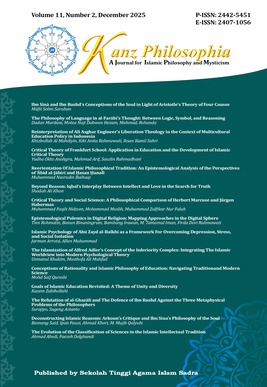
THE ISLAMIZATION OF ALFRED ADLER’S CONCEPT OF THE INFERIORITY COMPLEX
INTEGRATING THE ISLAMIC WORLDVIEW INTO MODERN PSYCHOLOGICAL THEORY
DOI:
https://doi.org/10.20871/kpjipm.v11i2.465Keywords:
Alfred Adler, Inferiority Complex, IslamizationAbstract
The concept of the inferiority complex developed by Alfred Adler has been widely applied in contemporary psychology to explain conditions such as depression, anxiety, and personality disorders. However, existing solutions tend to be secular, overlooking the spiritual dimension and relying on partial approaches such as tabula rasa, heredity, or nativism, thereby lacking a holistic perspective. This study aims to explore and Islamize Adler’s concept of the inferiority complex by drawing on Adler’s works, Islamic sources, particularly the Qur’an and Hadith, as well as insights from modern Western psychologists and Muslim scholars. Employing a qualitative methodology with a library research approach, the study analyzes primary and secondary texts to identify secular elements in Adler’s theory and integrate them with Islamic principles. The findings show that while Adler’s concept is useful for understanding human psychology, it is rooted in a secular Western paradigm that emphasizes human autonomy and neglects dependence on God. Using Syed Muhammad Naquib al-Attas’s framework of Islamization of knowledge, the concept is reconstructed in three stages: De-Westernization (removing secular elements), integration (embedding values such as tawḥīd, fiṭrah, muḥāsabah, tawakkul, shukr, qanā‘ah, and ukhuwah Islāmiyyah), and Islamization (a comprehensive reconstruction aligned with the tawhidic worldview). The resulting framework is holistic, uniting psychological, social, and spiritual dimensions. Within this perspective, the inferiority complex not only addresses mental health but also strengthens faith, cultivates virtuous character, and affirms humanity’s role as God’s vicegerent (khalīfah). Thus, this study contributes to the development of modern Islamic psychology that is both relevant to Muslim communities and oriented toward worldly well-being and eternal happiness.
Downloads
References
Adler, Alfred. 1917. The Neurotic Constitution: Outlines of a Comparative Individualistic Psychology and Psychotherapy. New York: Moffat, Yard and Company.
———. 1927. The Practice and Theory of Individual Psychology. New York: Harcourt, Brace & World.
———. 1930. Understanding Human Nature. London: George Allen & Unwin.
———. 1931. What Life Should Mean to You. Boston: Little, Brown, and Company.
———. 1964. Superiority and Social Interest: A Collection of Later Writings. Edited by Heinz L. Ansbacher and Rowena R. Ansbacher. Evanston, IL: Northwestern University Press.
Ansbacher, Heinz, and Rowena R. Ansbacher. 1956. The Individual Psychology of Alfred Adler: A Systematic Presentation in Selections from His Writings. New York: Basic Books.
Attas, Syed Muhammad Naquib al. 1995. Prolegomena to the Metaphysics of Islam: An Exposition of the Fundamental Elements of the Worldview of Islam. Kuala Lumpur: International Institute of Islamic Thought and Civilization (ISTAC).
Badri, Malik. 1979. The Dilemma of Muslim Psychologists. London: MWH London Publishers.
Batthyany, Alexander. 2016. Logotherapy and Existential Analysis: Proceedings of the Viktor Frankl Institute Vienna. Cham: Springer.
Beck, Aaron T. 1976. Cognitive Therapy and the Emotional Disorders. New York: International Universities Press.
Cahyaningtyas, Kania, Syamsu Yusuf, Nadia Aulia Nadhirah, and Irfan Fahriza. 2020. “Inferiority Complex Pada Mahasiswa.” Journal of Education and Counseling (JECO) 1 (1): 1–7. https://doi.org/10.32627/jeco.v1i1.31.
Carrington, Stuart C., Martin James Turner, Jamie S. North, and Abbe Brady. 2025. “Development, Validation, and Reliability of the Irrational Beliefs Scale for Sports Officials (IBSSO).” Frontiers in Psychology 16 (April): 1571447. https://doi.org/10.3389/fpsyg.2025.1571447.
Çimşir, Elif, and Ramazan Akdoğan. 2024. “Inferiority Feelings and Internet Addiction among Turkish University Students in the Context of COVID-19: The Mediating Role of Emotion Dysregulation.” Current Psychology 43 (5): 4245–54. https://doi.org/10.1007/s12144-023-04661-7.
Cox, Julia Revillion, Ruben G. Martinez, and Michael A. Southam-Gerow. 2019. “Treatment Integrity in Psychotherapy Research and Implications for the Delivery of Quality Mental Health Services.” Journal of Consulting and Clinical Psychology 87 (3): 221–33. https://doi.org/10.1037/ccp0000370.
Daud, Wan Mohd Nor Wan. 1998. The Educational Philosophy and Practice of Syed Muhammad Naquib Al-Attas: An Exposition of the Original Concept of Islamization. Kuala Lumpur: International Institute of Islamic Thought and Civilization (ISTAC).
Ellis, Albert. 1994. Reason and Emotion in Psychotherapy. Secaucus, NJ: Carol Publishing.
Eysenck, Hans J. 1970. The Structure of Human Personality. Vol. 3. London: Methuen.
Fereydouni, Shapour, and Simon Forstmeier. 2022. “An Islamic Form of Logotherapy in the Treatment of Depression, Anxiety and Stress Symptoms in University Students in Iran.” Journal of Religion and Health 61 (1): 139–57. https://doi.org/10.1007/s10943-021-01495-0.
Frankl, Viktor E. 1959. Man’s Search for Meaning. Boston: Beacon Press.
Fromm, Erich. 1947. Man for Himself: An Inquiry into the Psychology of Ethics. New York: Rinehart & Company.
Ghazālī, Abū Ḥāmid al-. 2005. Iḥyā’ ‘Ulūm al-Dīn. Beirūt: Dār al-Kotob al-‘Ilmiyyah.
Hakim, Usmanul, and Winda Roini. 2019. “Identifikasi Worldview dalam Ilmu Pengetahuan Barat Kontemporer Menurut Syed Muhammad Naquib Al Attas.” Tasfiyah: Jurnal Pemikiran Islam 3 (2): 53–72. https://doi.org/10.21111/tasfiyah.v3i2.3498.
Henriksen, Richard C., Susan E. Henderson, Ya‐Wen (Melissa) Liang, Richard E. Watts, and Danielle F. Marks. 2019. “Counselor Supervision: A Comparison Across States and Jurisdictions.” Journal of Counseling & Development 97 (2): 160–70. https://doi.org/10.1002/jcad.12247.
Hidayatullah, Elit Ave, and Syamsuddin Arif. 2022. “Syed Muhammad Naquib Al-Attas’ Exposition on the Concept of Ethics.” Jurnal Akidah & Pemikiran Islam 24 (1): 409–46. https://doi.org/10.22452/afkar.vol24no1.12.
Hoffman, Edward. 1994. The Drive for Self: Alfred Adler and the Founding of Individual Psychology. Reading, Massachusetts: Addison-Wesley.
———. 2019. The Positive Psychology of Abraham Maslow. London: Routledge.
Hume, Romy. 2022. “Show Me the Real You: Enhanced Expression of Rogerian Conditions in Therapeutic Relationship Building with Autistic Adults.” Autism in Adulthood 4 (2): 151–63. https://doi.org/10.1089/aut.2021.0065.
Ihsan, Nur Hadi, Khasib Amrullah, Usmanul Khakim, and Hadi Fatkhurrizka. 2021. “Hubungan Agama dan Sains: Telaah Kritis Sejarah Filsafat Sains Islam dan Modern.” Intizar 27 (2): 97–111. https://doi.org/10.19109/intizar.v27i2.9527.
Jawziyyah, Ibn Qayyim al-. 2003. Madārij al-Sālikīn. Beirūt: Dār al-Kutub al-‘Ilmiyyah.
Jung, Carl Gustav. 1953. Psychological Types. London: Routledge & Kegan Paul.
Kałużna-Wielobób, Alina, Włodzimierz Strus, and Jan Cieciuch. 2020. “Community Feeling and Narcissism as Two Opposite Phenomena.” Frontiers in Psychology 11 (October): 515895. https://doi.org/10.3389/fpsyg.2020.515895.
Khakim, Usmanul. 2024. “Islamic Worldview-based Corporate Social Responsibility.” Dissertation, Ponorogo: Universitas Darussalam Gontor.
Kirschenbaum, Howard. 2019. Carl Rogers: Dialogues and Essays. London: Routledge.
Li, Jiajian, Shuxin Jia, Lishen Wang, Mingming Zhang, and Shunsen Chen. 2023. “Relationships among Inferiority Feelings, Fear of Negative Evaluation, and Social Anxiety in Chinese Junior High School Students.” Frontiers in Psychology 13 (January): 1015477. https://doi.org/10.3389/fpsyg.2022.1015477.
Malivoire, Bailee L., Kathleen E. Stewart, Kathleen Tallon, Melina M. Ovanessian, Elizabeth J. Pawluk, and Naomi Koerner. 2019. “Negative Urgency and Generalized Anxiety Disorder Symptom Severity: The Role of Self-Reported Cognitive Processes.” Personality and Individual Differences 145 (July): 58–63. https://doi.org/10.1016/j.paid.2019.03.021.
Rogers, Carl R. 1951. Client-Centered Therapy: Its Current Practice, Implications, and Theory. Boston: Houghton Mifflin.
Rothman, Abdallah. 2021. Developing a Model of Islamic Psychology and Psychotherapy: Islamic Theology and Contemporary Understandings of Psychology. New York: Routledge. https://doi.org/10.4324/9781003104377.
Sadiq, Riffat. 2023. “Translation and Adaptation of Inferiority Complex Scale [ICS-10].” Annals of Human and Social Sciences 4 (2): 490–98. https://doi.org/10.35484/ahss.2023(4-II)45.
Saged, Ali Ali Gobaili, Che Zarrina Sa’ari, Mustaffa Bin Abdullah, Waleed Mugahed Al-Rahmi, Wail Muin Ismail, Mohamed Ibrahim Adam Zain, and Nourah Bint Abdullah Bin Mtaib alShehri. 2022. “The Effect of an Islamic-Based Intervention on Depression and Anxiety in Malaysia.” Journal of Religion and Health 61 (1): 79–92. https://doi.org/10.1007/s10943-021-01484-3.
Salam, Abdul Hanan Bin Abdul, and Nur Syamim Syahirah Mat Hussin. 2025. “Islamization of Education in Malaysia: The Influence and Legacy of Ismail Raji Al-Faruqi.” Kanz Philosophia: A Journal for Islamic Philosophy and Mysticism 11 (1): 69–88. https://doi.org/10.20871/kpjipm.v11i1.396.
Seligman, Martin. 2011. Flourish: A Visionary New Understanding of Happiness and Well-Being. New York: Free Press.
Shen, Huadong, Mu Li, and Li Li. 2022. “Influence of Social Exclusion on the Inferiority Feeling of Community Youth.” Iranian Journal of Public Health, ahead of print, July 17, 2022. https://doi.org/10.18502/ijph.v51i7.10091.
Souza, Gustavo Henrique Silva De, Jorge Artur Peçanha De Miranda Coelho, Nilton Cesar Lima, Germano Gabriel Lima Esteves, Fernanda Cristina Barbosa Pereira Queiroz, and Yuri Bento Marques. 2024. “Self-Actualization and B-Values: Development and Validation of Two Instruments in the Brazilian Context.” PLOS ONE 19 (6): e0302322. https://doi.org/10.1371/journal.pone.0302322.
Sulaiman, Ahmad. 2023. “Islamic Worldview in The Perspective of M.T.M Yazdī and S.M.N Al-Attas and Their Implication on Islamization of Knowledge.” Kanz Philosophia: A Journal for Islamic Philosophy and Mysticism 9 (1): 43–62. https://doi.org/10.20871/kpjipm.v9i1.251.
Sutoyo, Yongki. 2022. “Toward Islamic Methodology of Scientific Research Programmes in Natural Sciences: Contribution of Al-Attas and Lakatos.” Thesis, Ponorogo: Universitas Darussalam Gontor.
Tümlü, Gamze Ülker, and Bircan Kırlangıç Şimşek. 2021. “The Effects of Psychodrama Groups on Feelings of Inferiority, Flourishing, and Self-Compassion in Research Assistants.” The Arts in Psychotherapy 73 (April): 101763. https://doi.org/10.1016/j.aip.2021.101763.
Waharjani, Waharjani, Mohammad Jailani, and Miftachul Huda. 2024. “The Concept of Human Fiṭrah in Islamic Philosophy of Education: A Semantic Analysis in Relation to The Qur’an.” Kanz Philosophia: A Journal for Islamic Philosophy and Mysticism 10 (1): 95–120. https://doi.org/10.20871/kpjipm.v10i1.307.
Wang, Lei, Yeerzhati Yeerjiang, Hai Feng Gao, Jian Feng Pei, Ruo Xin Zhang, and Wang Hong Xu. 2022. “Self-Reported Anxiety Level and Related Factors in Senior High School Students in China during the Outbreak of Coronavirus Disease 2019.” Journal of Affective Disorders 301 (March): 260–67. https://doi.org/10.1016/j.jad.2022.01.056.
Warnock-Parkes, Emma, Jennifer Wild, Graham Thew, Alice Kerr, Nick Grey, and David M. Clark. 2022. “‘I’m Unlikeable, Boring, Weird, Foolish, Inferior, Inadequate’: How to Address the Persistent Negative Self-Evaluations That Are Central to Social Anxiety Disorder with Cognitive Therapy.” The Cognitive Behaviour Therapist 15: e56. https://doi.org/10.1017/S1754470X22000496.
Xie, LongSheng, Min Tian, Wei Wei, JianLan Ren, YuBei Liu, ZhaoLan Yu, and YanHua Chen. 2025. “The Development and Validation of the Irrational Beliefs Scale for People Living with HIV.” BMC Public Health 25 (1): 2494. https://doi.org/10.1186/s12889-025-23611-5.
Yalom, Irvin D. 1980. Existential Psychotherapy. New York: Basic Books.
Yang, Di, Baiyang Qiu, Jin Jiang, Youkui Xia, Lingxiao Li, Yanting Li, Longli Luo, Xiaocui Liu, and Jing Meng. 2023. “Development of Inferiority-Compensation Scale among High School Students.” BMC Medical Education 23 (1): 23. https://doi.org/10.1186/s12909-022-03979-3.
Yusuf, Hamza. 2004. Purification of the Heart: Signs, Symptoms and Cures of the Spiritual Diseases of the Heart. Chicago: Starlatch Press.
Downloads
Published
How to Cite
Issue
Section
License
Copyright (c) 2025 Usmanul Khakim, Musthofa Ali Mahfud

This work is licensed under a Creative Commons Attribution 4.0 International License.


Journal Tools


Evaluation Progress Scopus

Article Template

Google Scholar Citations

Sinta

CITEDNESS IN SCOPUS

Current Issue


Information
MAPS