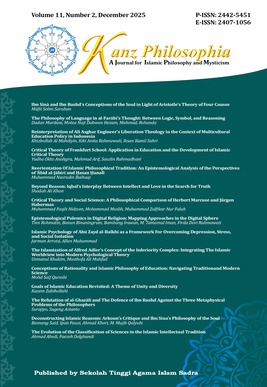
ISLAMIC PSYCHOLOGY OF ABŪ ZAYD AL-BALKHĪ AS A FRAMEWORK FOR OVERCOMING DEPRESSION, STRESS, AND SOCIAL ISOLATION
DOI:
https://doi.org/10.20871/kpjipm.v11i2.459Keywords:
Abū Zayd al-Balkhī, Biopsychosocial-Spiritual Model, Cultural Adaptation, Islamic Psychology, Mental HealthAbstract
The contemporary global mental health crisis—marked by rising rates of depression, chronic stress, and social disconnection—calls for approaches that integrate biological, psychological, social, and spiritual dimensions of human well-being. This study revisits the biopsychological framework of Abū Zayd al-Balkhī (850–934 CE), articulated in Maṣāliḥ al-Abdān wa al-Anfus, to assess its relevance for contemporary challenges. Drawing on a qualitative literature review and comparative analysis, the research highlights how al-Balkhī’s classifications of ḥuzn (sorrow/depression), waswasah (obsessive rumination), and faza‘ (panic) bear conceptual parallels to modern diagnostic categories, while his therapeutic strategies—including cognitive reflection, behavioral regulation, spiritual devotion, and social companionship—demonstrate an integrative orientation that resonates with, but is not reducible to, contemporary therapies such as Cognitive Behavioral Therapy (CBT), positive psychology, and mindfulness. The paper also underscores the epistemological and clinical challenges of adapting al-Balkhī’s framework today. These include differences in ontology and methodology, terminological disparities with DSM/ICD systems, lack of empirical validation, and the risk of decontextualization if his thought is applied without critical adaptation. Nevertheless, the study argues that al-Balkhī’s synthesis of Qur’anic theology, Greco-Arabic medicine, and philosophical rationalism offers valuable resources for developing culturally resonant and ethically grounded models of care. His legacy can enrich mental health discourse in Muslim-majority contexts and pluralistic societies alike, provided it is engaged reflexively, critically, and in dialogue with contemporary clinical evidence.
Downloads
References
American Psychological Association (APA). 2022. “Stress in America 2022: A National Mental Health Crisis.” 2022. https://www.apa.org/news/press/releases/stress.
Arroisi, Jarman, Aflatun Muchtar, Farhah, and Firda Inayah. 2024. “Relasi Pengetahuan dan Perilaku (Tinjauan Pemikiran Fakhruddin Al-Razi).” Kalimah: Jurnal Studi Agama dan Pemikiran Islam 22 (2): 217–34. https://doi.org/https://doi.org/10.21111/klm.v22i2.12373.
Arroisi, Jarman, Husain Zahrul Muhsinin, and Ahmad Rizqi Fadlilah. 2024. “Self-Transcendence in Transpersonal Psychology: A Critical Review from the Perspective of the Islamic Worldview.” International Journal of Emerging Issues in Islamic Studies 4 (1): 69–81. https://doi.org/https://doi.org/10.31098/ijeiis.v4i1.2432.
Arroisi, Jarman, Rodhi Hakiki Bin Cecep Mustopa Mustopa, and Royyan Ramdhani Djayusman. 2024. “Coping with the Discrepancy between Moral and Intellectual Achievement: The Model Integration of Higher Education and Modern Islamic Boarding Schools in Indonesia.” Indonesian Journal of Islam and Muslim Societies 14 (2): 231–57. https://doi.org/10.18326/ijims.v14i2.231-257.
Attas, Syed Muhammad Naquib al-. 1980. The Concept of Education in Islam. Kuala Lumpur, Malaysia: International Institute of Islamic Thought and Civilization (ISTAC).
———. 1993. Islam and Secularism. Kuala Lumpur, Malaysia: International Institute of Islamic Thought and Civilization (ISTAC).
Badri, Malik. 2000. Contemplation: An Islamic Psychospiritual Study. Edited by Abdul-Wahid Lu’lu’a. London, Washington: International Institute of Islamic Thought (IIIT).
———. 2013. Abu Zayd Al-Balkhi’s Sustenance of the Soul: The Cognitive Behavior Therapy of a 9th Century Physician. London, Washington: International Institute of Islamic Thought (IIIT).
Balkhī, Abū Zayd al-. 2004. Maṣāliḥ al-Abdān wa al-Anfus. Edited by Mālik Badrī. Riyāḍ: Markaz al-Malik Fayṣal li al-Buḥūth wa al-Dirāsāt al-Islāmiyyah.
Borrell-Carrió, Francesc, Anthony L. Suchman, and Ronald M. Epstein. 2004. “The Biopsychosocial Model 25 Years Later: Principles, Practice, and Scientific Inquiry.” Annals of Family Medicine 2 (6): 576–82. https://doi.org/10.1370/afm.245.Department.
Chavarria, Victor, Blanca De La Puente, Laura Gimenez, Cristina Pou, Carlos Peña-salazar, Isabel Grimal, and Josep Maria Haro. 2023. “Spirituality, Religiosity and Mental Health: A Clinical-Care Approach.” National Library of Medicine 51 (6): 281–82. https://doi.org/https://pubmed.ncbi.nlm.nih.gov/38321718/.
Cook, Christopher C. H., and Andrew Powell. 2022. Spirituality and Psychiatry. Cambridge: Cambridge University Press.
Engel, George L. 1977. “The Need for a New Medical Model: A Challenge for Biomedicine.” Science 196 (4286): 129–36. https://doi.org/https://doi.org/10.1126/science.847460.
Fernando, Suman. 2010. Mental Health, Race and Culture Second Edition. Edited by Jo Campling. New York: Palgrave Macmillan.
Foa, Edna B, Elizabeth A Hembree, and Barbara Olasov Rothbaum. 2007. Prolonged Exposure Therapy for PTSD: Emotional Processing of Traumatic Experiences. Edited by David H Barlow. New York: Oxford University Press.
Ghaemi, S. Nassir. 2010. The Rise and Fall of the Biopsychosocial Model: Reconciling Art and Science in Psychiatry. Baltimore: Johns Hopkins University Press.
Gutas, Dimitri. 1998. Greek Thought, Arabic Culture. London: Routledge.
———. 2014. Avicenna and the Aristotelian Tradition: Introduction to Reading Avicenna’s Philosophical Works. Edited by Hans Daiber, Anna Akasoy, and Emilie Savage-Smith. Leiden, Boston: Brill.
Haque, Amber. 2004. “Psychology from an Islamic Perspective: Contributions of Early Muslim Scholars and Challenges to Contemporary Muslim Psychologists.” Journal of Religion and Health 4 (43): 357–77. https://doi.org/https://doi.org/10.1007/s10943-004-4302-z.
Haque, Amber, Fahad Khan, Hooman Keshavarzi, and Abdallah E Rothman. 2016. “Integrating Islamic Traditions in Modern Psychology: Research Trends in Last Ten Years.” Journal of Muslim Mental Health 10 (1): 75–100. https://doi.org/http://dx.doi.org/10.3998/jmmh.10381607.0010.107.
Hedayat-Diba, Zari. 2000. “The Islamic Tradition and Clinical Psychology.” APA Bulletin, 2000.
Holt-lunstad, Julianne, Timothy B Smith, and J Bradley Layton. 2010. “Social Relationships and Mortality Risk: A Meta-Analytic Review.” PLoS Medicine 7 (7): 1–20. https://doi.org/10.1371/journal.pmed.1000316.
Keshavarzi, Hooman, and Amber Haque. 2013. “Outlining a Psychotherapy Model for Muslim Clients: Integrating the Classical Writings of Muslim Scholars with Modern Psychotherapy Approaches.” Psychotherapy 50 (3): 372–77. https://doi.org/https://doi.org/10.1037/a0029823.
Killgore, William. D. S, Sarah A Cloonan, Erin C Taylor, Dakota A Lucas, and Natalie S Dailey. 2020. “Loneliness: A Signature Mental Health Concern in the Era of COVID-19.” Psychiatry Research 29: 113–17. https://doi.org/https://doi.org/10.1016/j.psychres.2020.113117.
Killgore, William D S, Sara A Cloonan, Emily C Taylor, and Natalie S Dailey. 2020. “Letter to the Editor Loneliness: A Signature Mental Health Concern in the Era of COVID-19.” Psychiatry Research 290 (May): 113–17. https://doi.org/10.1016/j.psychres.2020.113117.
Kolk, Besser Van der. 2014. The Body Keeps the Score: Brain, Mind, and Body in the Healing of Trauma. 1st ed. New York: Penguin Books.
Layous, Kristin, and Sonja Lyubomirsky. 2014. “The How, Why, What, When, and Who of Happiness: Mechanisms Underlying the Success of Positive Activity Interventions.” In Positive Emotion: Integrating the Light Sides and Dark Sides, edited by June Gruber and Judith Tedlie Moskowitz. New York: Oxford University Press. https://doi.org/10.1093/acprof:oso/9780199926725.003.0025.
Long, Anthony Arthur. 2002. Epictetus: A Stoic and Socratic Guide to Life. Philosophie Antique. USA: Oxford University Press. https://doi.org/10.4000/philosant.7388.
Mascella, Vivian. 2013. “Depression: Causes and Treatment.” Estudos de Psicologia I Campinas 2 (30): 23–25. https://doi.org/10.1590/S0103-166X2013000200016.
Mitha, Karim. 2019. “Islamically Integrated Psychotherapy: Contextualising Psychotherapy for Muslim Clients.” Psychotherapy and Politics International 17 (1): 14–18.
Mohr, Sylvia. 2012. “Spirituality and Mental Health: A Clinical Perspective.” The Journal of Nervous and Mental Disease 200 (7): 548–52. https://doi.org/https://doi.org/10.1097/NMD.0b013e31825bfb20.
Murata, Sachiko, and William C Chittick. 1998. The Vision of Islam. Edited by Roger Corless and R. Ninian Smart. St. Paul, Minnesota: Paragon House.
Nasr, Seyyed Hossein. 1968. Man and Nature: The Spiritual Crisis in Modern Man. London: Unwin Paperbacks.
———. 1989. Knowledge and the Sacred. New York: State University of New York Press.
———. 1996. Religion and the Order of Nature. New York: Oxford University Press.
———. 2003. A Young Muslim’s Guide to the Modern World. Chicago: Kazi Publications, Inc.
Nasr, Seyyed Hossein, and Oliver Leaman. 2001. History of Islamic Philosophy. London and New York: Routledge.
Nesse, Randolph M. 2019. Good Reasons for Bad Feelings: Insights from the Frontier of Evolutionary Psychiatry. New York: Dutton.
Pargament, Kenneth I. 2001. The Psychology of Religion and Coping: Theory, Research, Practice. New York, London: The Guilford Press.
Puchalski, Christina, Betty Ferrell, Rose Virani, Shirley Otis-Green, and Pamela Baird. 2009. “Improving the Quality of Spiritual Care as a Dimension of Palliative Care: The Report of the Consensus Conference.” Journal of Palliative Medicine 12 (10): 885–904. https://doi.org/10.1089/jpm.2009.0142.
Rassool, Goolam Hussein. 2016. Islamic Counselling: An Introduction to Theory and Practice. London and New York: Routledge.
———. 2023. Islāmic Psychology: The Basics. London and New York: Routledge. https://doi.org/10.4324/9781003312956.
Rāzī, Abū Bakr Muḥammad ibn Zakariyyā al-. 2000. Al-Ḥāwī fī al-Ṭibb. Edited by Muḥammad Muḥammad Ismā‘īl. Beirūt: Dār al-Kutub al-‘Ilmiyyah.
Seligman, M. E. P., and M. Csikszentmihalyi. 2000. “Positive Psychology: An Introduction.” American Psychologist 55 (1): 5–14. https://doi.org/https://doi.org/10.1037/0003-066X.55.1.5.
Sīnā, Abū ‘Alī al-Ḥusayn ibnu ‘Alī Ibn. 1999. Al-Qanūn fī al-Ṭibb. Beirūt: Dār al-Kutub al-‘Ilmiyyah.
Sulmasy, Daniel P. 2002. “A Biopsychosocial-Spiritual Model for the Care of Patients at the End of Life.” The Gerontologist 43 (3): 24–33. https://doi.org/https://doi.org/10.1093/geront/42.suppl_3.24.
Turkle, Sherry. 2010. Alone Together: Why We Expect More from Technology and Less from Each Other. New York: Basic Books.
Twenge, Jean M. 2017. IGen: Why Today’s Super-Connected Kids Are Growing Up Less Rebellious, More Tolerant, Less Happy—and Completely Unprepared for Adulthood. New York: Atria Books.
Twenge, Jean M., Brian Spitzberg, and W. Keith Campbell. 2019. “Less In-Person Social Interaction with Peers among U.S. Adolescents in the 21st Century and Links to Loneliness.” Journal of Social and Personal Relationships 36 (6): 1892–1913. https://doi.org/http://dx.doi.org/10.1177/0265407519836170.
Wade, Derick T, and Peter W Halligan. 2017. “The Biopsychosocial Model of Illness: A Model Whose Time Has Come.” Sage Journals 31 (8): 995–1004. https://doi.org/https://doi.org/10.1177/0269215517709890.
Weatherhead, Stephen, and Anna Daiches. 2010. “Muslim Views on Mental Health and Psychotherapy.” Psychology and Psychotherapy: Theory, Research and Practice 83 (1): 75–89. https://doi.org/https://doi.org/10.1348/147608309X467807.
World Health Organization. 2023. World Mental Health Report 2023: Transforming Mental Health for All. Switzerland: WHO Press.
World Health Organization (WHO). 2023. “Depression Fact Sheet.” 2023. https://www.who.int/news-room/fact-sheets/detail/depression.
Downloads
Published
How to Cite
Issue
Section
License
Copyright (c) 2025 Jarman Arroisi, Allan Muhammad

This work is licensed under a Creative Commons Attribution 4.0 International License.


Journal Tools


Evaluation Progress Scopus

Article Template

Google Scholar Citations

Sinta

CITEDNESS IN SCOPUS

Current Issue


Information
MAPS