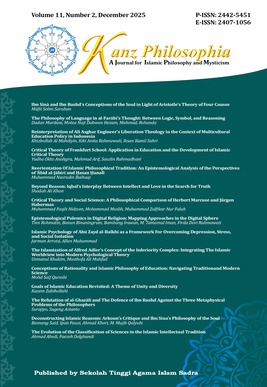
THE PHILOSOPHY OF LANGUAGE IN AL-FARĀBĪ’S THOUGHT
BETWEEN LOGIC, SYMBOL, AND REASONING
DOI:
https://doi.org/10.20871/kpjipm.v11i2.447Keywords:
Al-Farābī, Philosophy of Language, Logic, Reasoning, SymbolAbstract
Al-Farābī’s contributions to Islamic philosophy extend deeply into the philosophy of language, yet scholarly attention to this dimension remains limited. This study re-examines al-Farābī’s linguistic philosophy by focusing on three interrelated dimensions: logic, symbol, and reasoning. The background of the research lies in the need to reassess classical frameworks in light of contemporary debates on language, cognition, and meaning, where non-Western traditions remain underrepresented. The objective is to explicate how al-Farābī conceptualizes language not merely as a communicative tool, but as an epistemic system for organizing rational thought and symbolic representation. Using a qualitative method, the study employs textual-philosophical analysis of al-Farābī’s major works, including Kitāb al-Ḥurūf, Kitāb al-Alfāẓ al-Musta‘mala fī al-Manṭiq, and his commentary on De Interpretatione, supported by recent scholarly findings. The results reveal that al-Farābī understands language as a structured expression of the intellect, capable of conveying both demonstrative propositions and imaginative constructs. His classification of syllogisms into demonstrative, dialectical, rhetorical, poetic, and sophistical shows the multiplicity of language functions, each with distinct epistemological and moral purposes. Furthermore, his reflections on metaphor, rhetoric, and prophetic discourse demonstrate the cognitive and ethical role of symbolic language in shaping society and cultivating virtue. The study concludes that al-Farābī’s philosophy of language integrates logical rigor with symbolic depth, offering an early model of semiotic realism in which words, concepts, and referents form a triadic relationship grounded in reason and truth. This synthesis provides a foundational contribution to the Islamic intellectual tradition while also enriching contemporary philosophy of language, hermeneutics, and intercultural dialogue.
Downloads
References
Abed, Shukri B. 1991. Aristotelian Logic and Arabic Language in Alfārābi. Albany, NY: SUNY Press.
Agab, Adil Hassan Abdelrhman. 2023. “Philosophical Aspects of Language Origin: Al-Frabi’s Perspectives.” Academic International Journal of Social Sciences and Humanities 1 (1): 63–67.
Altaev, Zhakypbek, Aliya Massalimova, Assyl Tuleubekov, and Aizhan Doskozhanova. 2020. “Essence and Typology of Intellect in Al-Farabi’s Epistemology.” Bilig, no. 95 (October): 795–95. https://doi.org/10.12995/bilig.9504.
Aouad, Maroun, and Gregor Schoeler. 2002. “The Poetic Syllogism According to Al-Fārābī: An Incorrect Syllogism of the Second Figure.” Arabic Sciences and Philosophy 12 (2): 185–96. https://doi.org/10.1017/S0957423902002096.
Asghar, Muhammad, and Shahzad Shahzad. 2020. “Revisiting Al-Farabi’s Linguistic Theory: A Comparative Study with Contemporary Linguistics.” Journal of Islamic Thought and Civilization 10 (2): 45–62.
Azzuhri, Anggi. 2022. “Introducing Al-Farabi’s Political Philosophy to the Modern Politics: Correlating Al-Farabi’s Philosophy with the Modern Politics.” Australian Journal of Islamic Studies 7 (2): 22–34. https://doi.org/10.55831/ajis.v7i2.443.
Bahrani, Morteza. 2023. “Al-Farabi on the Power of Language: The Role of Expression in the Formation of Societies.” Islamic Political Thought 10 (1): 81–92. https://doi.org/10.30497/ipt.2023.75848.
Baizhuma, Samet, Bekzhan Meirbayev, Ainura Kurmanaliyeva, Marzhan Alikbayeva, and Nurgul Tutinova. 2025. “The Religious Aspect of the Concept of ‘Virtuous Man’ in the Legacy of Al-Farabi.” Journal of Ecohumanism 4 (1): 3146–51. https://doi.org/10.62754/joe.v4i1.6117.
Bakker, Paul J. J. M. 2018. “Success and Suppression: Arabic Sciences and Philosophy in the Renaissance by Dag Nicolaus Hasse.” Journal of the History of Philosophy 56 (3): 557–58. https://doi.org/10.1353/hph.2018.0056.
Benevich, Fedor. 2020. “Individuation and Identity in Islamic Philosophy after Avicenna: Bahmanyār and Suhrawardī.” British Journal for the History of Philosophy 28 (1): 4–28. https://doi.org/10.1080/09608788.2019.1604316.
Berman, L. V. 1967. “Quotations from Al-Farabi’s Lost ‘Rhetoric’ and His ‘Al-Fusul Al-Muntaza’a.’” Journal of Semitic Studies 12 (2): 268–72. https://doi.org/10.1093/jss/12.2.268.
Chatti, Saloua. 2014. “Syncategoremata in Arabic Logic, al-Fārābī and Avicenna.” History and Philosophy of Logic 35 (2): 167–97. https://doi.org/10.1080/01445340.2014.891372.
Cohen, Mordechai. 2002. Logic to Interpretation: Maimonides’ Use of al-Fârâbî’s Model of Metaphor. Zutot 2 (1): 104–13. https://doi.org/10.1163/187502102788638905.
Daneshgar, Majid. 2020. “The Future of Islam and Science: Philosophical Grounds.” Zygon: Journal of Religion and Science 55 (4): 971–76. https://doi.org/10.1111/zygo.12647.
El-Bizri, Nader. 2018. “Arabic Classical Traditions in the History of the Exact Sciences: The Case of Ibn al-Haytham.” The European Physical Journal Plus 133 (71): 271. https://doi.org/10.1140/epjp/i2018-12142-7.
Forcada, Miquel. 2020. “Bronze and Gold.” Oriens: Journal of Philosophy, Theology and Science in Islamic Societies 48 (3–4): 367–415. https://doi.org/10.1163/18778372-04803003.
Germann, Nadja. 2015. “Al-Fārābī on Logic as the Path to Happiness.” Oxford Studies in Medieval Philosophy 3: 33–61.
Griffel, Frank. 2012. “Al-Ghazālī’s Use of ‘Original Human Disposition’ (Fiṭra) and Its Background in the Teachings of al-Fārābī and Avicenna.” The Muslim World 102 (1): 1–32. https://doi.org/10.1111/j.1478-1913.2011.01376.x.
Halper, Yehuda. 2025. “Continuity, Limits, and Quantity in Al-Fārābī’s Paraphrase of Aristotle’s Categories.” British Journal for the History of Philosophy 33 (2): 229–43. https://doi.org/10.1080/09608788.2024.2404449.
Hodges, Wilfrid, and Manuela Giolfo. 2022. “Grammar and Logic in Al-Farabi’s Philosophy of Language.” Arabic Sciences and Philosophy 32 (1): 89–110.
Janssens, Jules. 2021. “Avicenna, Fī Al-‘Umūr Al-Kulliyya Min ‘Ilm Al-Ṭibb, Ed. Najafgholi Habibi.” Arabic Sciences and Philosophy 31 (2): 269–75. https://doi.org/10.1017/s0957423921000102.
Kamil, Ambreen, Sadaf Abbasi, Muhammad Umer Hayat, Gulzameen Kamil, and Naseem Mahmood. 2023. “Islamic Philosophy of Scientific Explorations and Modern Science: Analytical Study from Social Policy Perspective.” Al-Qanṭara 9 (4): 460–7.
Khalidi, Muhammad Ali. 2024. “Al-Farabi on Acquiring a Philosophical Concept.” British Journal for the History of Philosophy 32 (4): 704–24. https://doi.org/10.1080/09608788.2022.2083071.
Lamprakis, Alexander. 2024. “Al-Fārābī’s Eighth Fallacy Extra Dictionem and Averroes’ Criticism.” Arabic Sciences and Philosophy 34 (2): 233–74. https://doi.org/10.1017/S0957423924000043.
Laywine, Alison. 2023. “Al-Fārābī’s Conception of Music Theory as the Universal Science of Melody.” Oriens: Journal of Philosophy, Theology and Science in Islamic Societies 51 (1–2): 104–26. https://doi.org/10.1163/18778372-12340023.
Leezenberg, Michiel. 2021. “Of Prophecy and Piety: Spinoza’s Tractatus Theologico-Politicus between al-Farabî and Erasmus.” Philosophies 6 (2): 51. https://doi.org/10.3390/philosophies6020051.
López-Farjeat, Luis Xavier. 2019. “Cosmología, biología y origen del alma en al-Fārābī y Avicena.” Ideas y Valores 68 (169): 13–32. https://doi.org/10.15446/ideasyvalores.v68n169.76984.
Mahdi, Muhsin. 1970. “Language and Logic in Classical Islam.” In Logic in Classical Islamic Culture, edited by G. E. von Grunebaum. Wiesbaden: O. Harrassowitz.
Mahdī, Muḥsin. 1986. Kitāb Al-Alfāẓ al-Musta‘mala fī al-Manṭiq. Edited by Muhsin Mahdi. Beirūt: Dār al-Mashreq.
Makhlouf, Peter. 2024. “Prophecy Between Poetics and Politics from Al-Farabi to Leo Strauss.” International Journal of the Classical Tradition 31 (1): 1–29. https://doi.org/10.1007/s12138-022-00632-8.
Michel, Karine. 2019. “L’art politique et sa visée téléologique:Le bonheur chez Farabi, Miskawayh et le pseudo al-‘Āmiri.” Archives de Philosophie 82 (4): 701–18. https://doi.org/10.3917/aphi.824.0701.
Neria, Chaim Meir. 2013. “Al-Fārābī’s Lost Commentary on The Ethics: New Textual Evidence.” Arabic Sciences and Philosophy 23 (1): 69–99. https://doi.org/10.1017/S0957423912000082.
Özturan, Hümeyra. 2019. “The Practical Philosophy of Al-Farabi - and Avicenna: A Comparison.” Nazariyat-Journal for The History of Islamic Philosophy and Sciences 5 (1): 1–35. https://nazariyat.org/en/issues/volume-5-issue-1/m0071.
Siddiqi, Ahmed Ali. 2024. “Hardship, Recompense, and Divine Law: Al-Fārābī on the ‘Virtue of Struggle.’” Polity 56 (4): 584–607. https://doi.org/10.1086/732022.
Stefaniuk, Tomasz. 2022. “Man in Early Islamic Philosophy-Al-Kindi and Al-Farabi.” Ruch Filozoficzny 78 (3): 65–84. https://doi.org/10.12775/RF.2022.023.
Tahiri, Hassan. 2018. “When The Present Misunderstands The Past How A Modern Arab Intellectual Reclaimed His Own Heritage.” Arabic Sciences and Philosophy 28 (1): 133–58. https://doi.org/10.1017/S0957423917000108.
Versteegh, Kees. 1997. The Arabic Language. Edinburgh: Edinburgh University Press.
Zimmermann, F. W. 1981. Al-Farabi’s Commentary on Aristotle’s De Interpretatione. Edited by F. W. Zimmermann. London: Oxford University Press.
Zonta, Mauro. 2011. “About Todros Todrosi’s Medieval Hebrew Translation of al-Fārābī’s Lost Long Commentary/Gloss-Commentary on Aristotle’s Topics, Book VIII.” History and Philosophy of Logic 32 (1): 37–45. https://doi.org/10.1080/01445340.2010.506093.
Downloads
Published
How to Cite
Issue
Section
License
Copyright (c) 2025 Dadan Mardani, Motea Naji Dabwan Hezam, Mahmud Mahmud, Rohanda Rohanda

This work is licensed under a Creative Commons Attribution 4.0 International License.


Journal Tools


Evaluation Progress Scopus

Article Template

Google Scholar Citations

Sinta

CITEDNESS IN SCOPUS

Current Issue


Information
MAPS