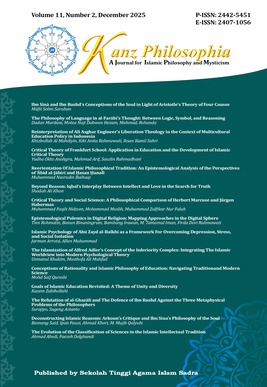
CONCEPTIONS OF RATIONALITY AND ISLAMIC PHILOSOPHY OF EDUCATION
NAVIGATING TRADITION AND MODERN SCIENCE
DOI:
https://doi.org/10.20871/kpjipm.v11i2.433Keywords:
Epistemology, Islamic Philosophy of Education, Pedagogy, Rationality, Scientific Advancements, Theistic EvolutionAbstract
This paper investigates the diverse conceptions of rationality within Islamic philosophy and their relevance to contemporary Islamic education, especially when considering modern scientific developments like evolution by natural selection, especially when connected with the development of Artificial Intelligence (AI) which is growing rapidly and starting to enter the world of education. The relationship between Islamic theology and scientific paradigms continues to be a topic of debate, which influences pedagogical approaches. A thorough understanding of the various Islamic rationalities, spanning from the early Islamic era to the classical period, is essential for creating an educational framework that promotes critical thinking while upholding Islamic values. Using a qualitative method, this writing examines the contributions of key figures such as al- Kindī, al-Farābī, Ibn Sīnā, al-Bīrūnī, al-Ghazālī, Ibn Tufayl, Ibn Rushd, Junayd al-Baghdādī, ‘Abd al-Qādir al-Jīlānī, Khwāja Mu‘īnuddīn Chishtī, and Jalāl al-Dīn Rūmī to illustrate the different forms of rational engagement in Islamic intellectual history. It is proposed that addressing the conflict between traditional Islamic teachings and modern scientific theories requires a reassessment of educational strategies and more expansive understanding of rationality itself.
Downloads
References
Ahwānī, Aḥmad Fuʼād al-. 1964. Al-Kindī: Faylasūf al-ʻArab. Qāhirah: Al-Muʼassasah al-Miṣrīyah al-ʻĀmmah lil-Taʼlīf wa-al-Tarjamah wa-al-Ṭibāʻah wa-al-Nashr.
Amin, Mohamed Eusuff Md. 2023. “Harmony in Paradox: Unveiling Jalāl al-Dīn al-Rūmī’s Universalism and Its Impact on Contemporary Islamic Thought.” Teosofi: Jurnal Tasawuf dan Pemikiran Islam 13 (1): 134–58. https://doi.org/10.15642/teosofi.2023.13.1.134-158.
Aminudin, and Masykur Arif. 2025. “Epistemology of Sufism and The Witness of Syekh Abdul Qadir Al-Jailani and Its Implications for The Treasure of Islamic Thought.” Living Sufism: Journal of Sufism and Psychotherapy 4 (1): 46–56. https://doi.org/10.59005/ls.v4i1.1011.
Anam, Rifqi Khairul. 2025. “Against Algorithmic Authority: Al-Ghazali, Digital Taqlid, and the Crisis of Epistemic Agency in the Age of AI.” Journal of Islamic Philosophy and Contemporary Thought 3 (1): 1–35. https://doi.org/10.15642/jipct.2025.3.1.1-35.
Armayanto, Harda, Adib Fattah Suntoro, Achmad Reza Hutama Al Faruqi, and Maria Ulfa. 2025. “Al-Kindī’s Metaphysics: The Integration of Greek Philosophy in Islamic Philosophy.” Kanz Philosophia: A Journal for Islamic Philosophy and Mysticism 11 (1): 89–104. https://doi.org/10.20871/kpjipm.v11i1.410.
Averroës. 2012. Averroes’ Tahafut al-Tahafut (The Incoherence of the Incoherence). Translated by Simon Van Den Bergh. UK: E. J. W. Gibb Memorial Trust.
Avicenna. 1952. Avicenna's Psychology: An English Translation of Kitāb al-Najāt, Book II, Chapter VI. Translated by Fazlur Rahman. Oxford: Oxford University Press.
———. 1973. The Canon of Medicine of Avicenna. Translated by O. C. Gruner. USA: AMS Press.
Bīrūnī, al-. 1910. Alberuni's India. Translated by Edward Sachau. London: Kegan Paul, Trench, Trübner & Co.
———. 1967. The Determination of the Coordinates of Places for the Correction of Distances Between Cities. Translated by Jafar Ali. Beirut: American University of Beirut Press.
Can, Şefik. 2005. Fundamentals of Rumi's Thought. London: The Light.
Dallal, Ahmad. 2010. Islam, Science, and the Challenge of History. New Haven: Yale University Press.
Erdoğan, İbrahim Halil, Sema Eryücel, İbrahim Halil Erdoğan, and Sema Eryücel. 2024. “The Concept of Divine Revelation According to Ibn Sînâ and Al-Ghazālī: A Comparative Analysis.” Religions 15 (11): 1383. https://doi.org/10.3390/rel15111383.
Farābī. Abū Naṣr al-. 2002. On the Perfect State. Translated by Richard Walzer. Oxford: Oxford University Press.
Fata, Ahmad Khoirul, Izzuddin, and Pepen Irpan Fauzan. 2025. “Metaphysics as the Ontological Foundation of the State: The Convergence of al-Farabi’s Political Thought and Pancasila in Indonesia.” Journal of Islamic Thought and Civilization 15 (2): 269–87. https://doi.org/10.32350/jitc.152.15.
Firdaus, Qusthan A. H., Aktobi Ghozali, and Azzimma Siswoyo Alghifary. 2025. “Islamic Philosophy and Artificial Intelligence: Mapping the Terrain.” Aqlania 16 (1): 1–22. https://doi.org/10.32678/aqlania.v16i1.1.
Ghazālī, al-. 1980. Deliverance from Error (al-Munqidh min al-Dalāl. Translated by Richard J. McCarthy. Boston: Twayne.
———. 2000. The Incoherence of the Philosophers. Translated by Michael E. Marmura. Provo, UT: Brigham Young University Press.
Guessoum, Nidhal. 2010. Islam's Quantum Question: Reconciling Muslim Tradition and Modern Science. Oxford: Oneworld Publications.
Hakim, Ahmad. 2021. “Counter-Discourse on The Criticism of Ibn Rushd Toward al-Ghazali.” Jurnal Theologia 32 (1): 63–88. https://doi.org/10.21580/teo.2021.32.1.8330.
Halim, Chandera, and Koleta Donna Indhayana Putri. 2025. “Artificial Intelligence As A Legal Subject: An Existentialist Philosophy Perspective.” Citizen : Jurnal Ilmiah Multidisiplin Indonesia 5 (2): 527–31. https://doi.org/10.53866/jimi.v5i2.712.
Hourani, Goerge F. 1963. “The Decisive Treatise, Determining What the Connection Is Between Religion and Philosophy.” In Medieval Political Philosophy: A Sourcebook, edited by Ralph Lerner and Muhsin Mahdi. Canada: Free Press of Glencoe.
Idris, Murad. 2016. “Producing Islamic Philosophy: The Life and Afterlives of Ibn Ṭufayl’s Ḥayy Ibn Yaqẓān in Global History, 1882–1947.” European Journal of Political Theory 15 (4): 382–403. https://doi.org/10.1177/1474885116666032.
Imtihanah, Anis Hidayatul, and Asep Syahrul Mubarok. 2022. “The Concept of Monotheism According to Junayd Al-Baghdādī and Its Implementation for Modern Community.” Kodifikasia 16 (2): 227–41. https://doi.org/10.21154/kodifikasia.v16i2.3301.
Jīlānī, ‘Abd al-Qādir al-. 2007. Revelations of the Unseen (Futūḥ al-Ghaib). Translated by Muhtar Holland. Texas: Al-Baz Publishing.
Kamali, Mohammad Hashim. 1999. Principles of Islamic Jurisprudence. Cambridge: Islamic Texts Society.
Khan, M. M. 2023. Artificial Intelligence, Ethics, and Islam: Navigating the Future with Faith. London: Kube Publishing.
Lubis, Ali Akhbar Abaib Mas Rabbani, and Fathur Rozi. 2020. “Rethinking The Book of Tahafut Al-Falasifah: Examining Al-Ghazali’s Argumentative Criticism Against the Thinking of Philosophers.” Indonesian Journal of Interdisciplinary Islamic Studies (IJIIS) 4 (1): 1–18. https://doi.org/10.20885/ijiis.vol4.iss1.art1.
Maulidia, Martarosa, Mahdaro Finetri, and Muhammad Fahmi. 2025. “When Teachers Are Digital: Islamic Education, Artificial Intelligence, and Ibn Sīnā’s Anxiety.” Kanz Philosophia: A Journal for Islamic Philosophy and Mysticism 11 (1): 131–52. https://doi.org/10.20871/kpjipm.v11i1.418.
Mujahidin, Sultan. 2024. “The Supremacy of Revelation over Reason: Al-Ghazali’s Critique of Rationalist Philosophy in Tahafut Al-Falasifah.” Islamic Thought Review 2 (2): 151–62. https://doi.org/10.30983/itr.v2i2.8838.
Nasr, Seyyed Hossein. 2006. Islamic Philosophy from its Origin to the Present: Philosophy in the Land of Prophecy. Albany: State University of New York Press.
Ningrum, Hazizah Mutiara Cahaya, Ali Nur Mualim, Sudarman Sudarman, and Fisman Bedi. 2024. “Artificial Intelligence in Al-Ghazali’s Perspective: Bridging the Concept of Nafs and Machine.” Islamic Thought Review 2 (2): 140–50. https://doi.org/10.30983/itr.v2i2.8849.
Putri, Fira Dwi, and Nabila Yasmin. 2025. “Al-Biruni’s Historical Method (973 M-1048 M) in Kitab Tarikh Al-Hind.” HISTORIA: Jurnal Program Studi Pendidikan Sejarah 14 (1): 389–404. https://doi.org/10.24127/hj.v14i1.12880.
Rahman, Zikri, and Akhmad Fauzi Hamzah. 2025. “The Position of Humans as Creatures with Thoughts: Philosophical Perspectives and the Emergence of Artificial Intelligence (AI) in the World of Education.” Al-Munawwarah: Journal of Islamic Education 1 (1): 39–47. https://doi.org/10.38073/almunawwarah.v1i1.2513.
Refinal, Mahyudin Ritonga, Rusydi, and Riki Saputra. 2025. “Epistemology of Knowledge: Bridging Western and Islamic Thought.” Solo International Collaboration and Publication of Social Sciences and Humanities 3 (01): 95–110. https://doi.org/10.61455/sicopus.v3i01.250.
Renard, John. 2009. The A to Z of Sufism. Lanham, MD: Scarecrow Press.
Saenong, Faried F. “Ellenchos Practices in Classical Islam: Hayy b. Yaqzan of Ibn Tufayl.” IJMIS: Istiqlal Journal on Mosque and Islamic Studies 1 (1): 45–62. https://doi.org/10.70017/ijmis.v1i1.5.
Sardar, Ziauddin. 2008. Science in Islam. New York: Routledge.
Sarkowi, Sarkowi. 2024. “Islamic Education with Ulul Albab Integration Paradigm: Pendidikan Islam Berparadigma Integrasi Ulul Albab.” Halaqa: Islamic Education Journal 8 (1): 97–104. https://doi.org/10.21070/halaqa.v8i1.1682.
Shadiqin, Sehat Ihsan, M. Agus Wahyudi, Alfiatunnur Alfiatunnur, and Shabrun Jamil. 2024. “Rumi Concept of Love: The Path to Interfaith Harmony and Peace.” Al-Albab 13 (2): 157–73. https://doi.org/10.24260/alalbab.v13i2.2986.
Stolz, Daniel A. 2022. “Science and Islam in Modernity.” Encyclopedia of the History of Science 4 (1): 1–29. https://doi.org/10.34758/sj2f-d525.
Taslaman, Caner. 2018. The Evolution Theory, the Big Bang and God. Istanbul: Istanbul University Press.
Tufayl, Ibn. 1972. Ibn Tufayl’s Hayy Ibn Yaqzān. Translated by Lenn Evan Goodman. New York: Twayne Publishers.
Ṭūsī, Abū Naṣr ‘Abdallah b. ‘Alī al-Sarrāj al-. 1914. The Kitāb al-Luma‘ fi 'l-Taṣawwuf of Abū Naṣr ‘Abdallah b. ‘Alī al-Sarrāj al-Ṭūsī. Edited by Reynold Alleyne Nicholson. London: Luzac & Co.
Downloads
Published
How to Cite
Issue
Section
License
Copyright (c) 2025 Mohd Saif Qureshi

This work is licensed under a Creative Commons Attribution 4.0 International License.


Journal Tools


Evaluation Progress Scopus

Article Template

Google Scholar Citations

Sinta

CITEDNESS IN SCOPUS

Current Issue


Information
MAPS