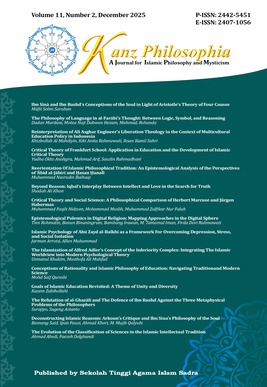
REORIENTATION OF ISLAMIC PHILOSOPHICAL TRADITION
AN EPISTEMOLOGICAL ANALYSIS OF THE PERSPECTIVES OF ‘ĀBID AL-JĀBIRĪ AND ḤASAN ḤANAFĪ
DOI:
https://doi.org/10.20871/kpjipm.v11i2.431Keywords:
‘Ābid al-Jābirī, Ḥasan Ḥanafī, Islamic Philosophy, Tajdīd, TurāthAbstract
Islamic philosophy, which once experienced a golden age, now faces a crisis of innovation characterized by stagnation, repetition, and an inability to respond to contemporary human problems. This condition is often seen as a result of the decline of philosophy after Ibn Rushd, but in fact it is more related to the inappropriate method of reading tradition (turāth) with two main axes: traditionalism/Salafism and liberalism-modernism. This article examines the thoughts of two very important modern Arab figures, ‘Ābid al-Jābirī and Ḥasan Ḥanafī, who both attempted to offer new ways of reading turāth to revitalize Islamic philosophy. The aim is to reveal the relevance of their methods in addressing intellectual stagnation while pointing to a new direction for the Islamic philosophical tradition to remain relevant and productive. This study uses a qualitative method based on content analysis of the main works of ‘Ābid al-Jābirī and Ḥasan Ḥanafī on tradition and renewal. The results of the study show that al-Jābirī, through structural, historical, and ideological criticism, attempts to liberate tradition, especially philosophical texts, from analogical reading (qiyās) and encourages a rationality of tradition that is more in line with the guidance of modernity. Meanwhile, Ḥasan Ḥanafī, through phenomenological hermeneutics, views tradition as an ideological force that must be revived in order to support emancipation and social transformation. Although their points of emphasis differ, both assert that Islamic philosophy can only regain its vitality through a reorientation of tradition so that it remains relevant and capable of responding to the needs of the times.
Downloads
References
Abu-Rabi’, Ibrahim M. 2004. Contemporary Arab Thought: Studies in Post-1967 Arab Intellectual History. London & Virginia: Pluto Press.
Adian, Donny Gahral. 2019. Pengantar Fenomenologi. Yogyakarta: Koeskoesan.
Arfa, Faisar Ananda, Syafiruddin Syam, and Muhammad Syukri Albani Nasution. 2015. Metode Studi Islam: Jalan Tengah Memahami Islam. Jakarta: PT RajaGrafindo Persada.
Bagir, Haidar. 2020. Mengenal Filsafat Islam: Pengantar Filsafat yang Ringkas, Menyeluruh, Praktis, dan Transformatif. Bandung: Mizan.
Boullata, Issa J. 2022. Dekonstruksi Tradisi: Gelegar Pemikiran Arab Islam. Translated by Imam Khoiri. Yogyakarta: LKiS.
Gutas, Dimitri. 2002. “The Study of Arabic Philosophy in the Twentieth Century: An Essay on the Historiography of Arabic Philosophy.” British Journal of Middle Eastern Studies 29 (1): 5–25. https://doi.org/10.1080/13530190220124043.
Ḥanafī, Ḥasan. 1992. Al-Turāth wa al-Tajdīd. Beirūt: Al-Mu’assah al-Jāmi‘ah li al-Dirāsat wa al-Nashr wa al-Tawzi‘.
———. 2012. Al-Huwiyyah. Cairo: Al-Majlis al-‘Ala lil-Thaqāfah.
Hanafi, Hasan. 2001. Turas dan Tajdid: Sikap Kita Terhadap Turas Klasik. Translated by Yudian Wahyudi. Yogyakarta: Titian Ilahi Press & Pesantren Pasca Sarjana Bismillah Press.
Hanafi, Hasan, and Muhammad Abid Al- Jabiri. 2015. Dialog Timur & Barat: Menuju Rekonstruksi Metodologis Pemikiran Politik Arab yang Progresif dan Egaliter. Translated by Umar Bukhory. Yogyakarta: IRCiSoD.
Hanafi, Hassan. 1995. Islam Wahyu Sekuler: Gagasan Kritis Hassan Hanafi. Translated by M. Zaki Husein and M. Nur Khoiron. Jakarta: Inst@d: Institute of Study for Transformation and Democracy.
———. 2002. “Phenomenology and Islamic Philosophy.” In Phenomenology World-Wide: Foundations — Expanding Dynamics — Life-Engagements. A Guide for Research and Study, edited by A. Ales Bello, M. Antonelli, G. Backhaus, O. Balaban, G. Baptist, J. Bengtsson, J. Benoist, et al., 318–22. Dordrecht: Springer Netherlands. https://doi.org/10.1007/978-94-007-0473-2_33.
———. 2004. Islamologi 2: Dari Rasionalisme ke Empirisme. Translated by Miftah Faqih. Yogyakarta: LKiS.
———. 2015. Studi Filsafat 1: Pembacaan Atas Tradisi Islam Kontemporer. Edited by Najib Kailani. Translated by Miftah Faqih. Yogyakarta: LKiS.
Hanssen, Jens, and Max Weiss, eds. 2018. Arabic Thought against the Authoritarian Age: Towards an Intellectual History of the Present. New York: Cambridge University Press.
Harb, Ali. 2012. Nalar Kritis Islam Kontemporer: Kritik & Dialog. Translated by Umar Bukhory and Ghazi Mubarak. Yogyakarta: IRCiSoD.
Hourani, Albert. Sejarah Bangsa-bangsa Muslim. Translated by Irfan Abubakar. Bandung: Mizan, 2004.
Jābirī, Muḥammad ‘Ābid al-. 1991. Al-Turāth wa al-Ḥadāthah: Dirāsāt wa Munāqashāt. Beirūt: Markaz Dirāsāt al-Waḥdah al-‘Arabiyyah.
———. 1993. Naḥnu wa al-Turāth (Qirā’at Mu‘āṣirah fī Turāthinā al-Falsafī). Beirūt: Al-Markaz al-Thaqāfī al-‘Arabī.
Jabiri, Muḥammad Abid al-. 2003. Kritik Kontemporer Atas Filsafat Arab-Islam. Translated by Moch. Nur Ichwan. Yogyakarta: Islamika.
———. 2015. Problematika Pemikiran Arab Kontemporer. Translated by Aksin Wijaya. Yogyakarta: Pustaka Pelajar.
———. 2018. Al-Jabiri, Eropa, dan Kita. Translated by Ahmad Baso. Tangerang Selatan: Pustaka Afid Jakarta.
Kersten, Carool. 2019. Contemporary Thought in the Muslim World: Trend, Themes, and Issues. London & New York: Routledge.
King, Richard, ed. 2017. Religion, Theory, Critique: Classic and Contemporary Approaches and Methodologies. New York: Columbia University Press.
Lahoud, Nelly. 2010. “Tradition (Turāts) in Contemporary Arabic Political Discourse.” Critique: Critical Middle Eastern Studies 13 (3): 313–33. https://doi.org/10.1080/1066992042000300675.
Muslih, Mohammad. 2012. “Pemikiran Islam Kontemporer: Antara Mode Pemikiran dan Model Pembacaan.” TSAQAFAH: Jurnal Peradaban Islam 8 (2): 347–68. https://doi.org/https://doi.org/10.21111/tsaqafah.v8i2.28.
Novia, Yunita. 2020. “Muḥammad ‘Ābid Al-Jābirī’s Thoughts on Tradition and Modernity in Renewal.” Al-Lubb: Journal of Islamic Thought and Muslim Culture (JITMC) 2 (2): 134–52. https://doi.org/http://dx.doi.org/10.51900/lubb.v2i2.8597.
Rasyidi, Abdul Haris. 2017. “Kajian Islamologi Tentang Tradisi Pembaharuan dan Modernitas; Telaah Buku Dirasat Islamiyyah Hassan Hanafi.” Jurnal Islam Nusantara 1 (2): 205–16. https://doi.org/10.33852/jurnalin.v1i2.36.
Ro’uf, Abdul Mukti. 2010. “Metode Pembacaan Turâts Arab-Islam: Perspektif Muhammad ‘Abid Al-Jâbirî.” Ulumuna: Jurnal Studi Keislaman 14 (1): 63–100.
Rufaiqoh, Elok, Umi Sumbulah, Ahmad Nuruddin, Asmad Hanisyi, and Zainal Arifin. 2023. “Hassan Hanafi’s Reformation in The Islamic World.” Jurnal Islam Nusantara 7 (2): 158–68. https://doi.org/https://doi.org/10.33852/jurnalnu.v7i2.448.
Saenong, Ilham B. 2002. Hermeneutika Pembebasan: Metodologi Tafsir Al-Quran Menurut Hassan Hanafi. Jakarta Selatan: Teraju.
Said, Karoui. 2023. “The Issue of Heritage and Renewal in Contemporary Thought: Hassan Hanafi is an Example.” ATTAKAMUL: Journal of Social and Sports Sciences Researches 7 (2): 44–63. https://doi.org/https://doi.org/10.34118/ajsssr.v7i2.3684.
Salimi, Abdulrahman Al-. 2024. Arab Philosophical Trends: Responses to Modernity. Edinburgh: Edinburgh University Press Ltd.
Salvatore, Armando. 1995. “The Rational Authentication of Turāth in Contemporary Arab Thought: Muḥammad Ābid Al-Jābirī and Ḥasan Ḥanafī.” The Muslim World 85 (3–4): 191–214. https://doi.org/https://doi.org/10.1111/J.1478-1913.1995.TB03618.X.
Sebti, Meryem. 2010. “The Decline of Thought in the Arab World According to Muhammad ‘Abed Al-Jabiri.” Diogenes 57 (2): 92–100. https://doi.org/10.1177/0392192110393216.
Shimogaki, Kazuo. 2011. Kiri Islam: Antara Modernisme dan Posmodernisme. Translated by M. Imam Aziz and M. Jadul Maula. Yogyakarta: LKiS.
Sholeh, A. Khudori, ed. 2003. Pemikiran Islam Kontemporer. Yogyakarta: Penerbit Jendela.
Syafrin, Nirwan. 2014. “New Approach in Religious Studies with Special Reference to Muhammad Abid Al-Jabiri.” TSAQAFAH: Jurnal Peradaban Islam 10 (2): 223–44. https://doi.org/10.21111/tsaqafah.v10i2.187.
Wijaya, Aksin. 2017. Nalar Kritis Epistemologi Islam: Membincang Dialog Kritis Para Kritikus Muslim: Al-Gazali, Ibnu Rusyd, Thaha Husein, M. Abid Al-Jabiri. Yogyakarta: Kalimedia.
Downloads
Published
How to Cite
Issue
Section
License
Copyright (c) 2025 Muhammad Nasrudin Baihaqi

This work is licensed under a Creative Commons Attribution 4.0 International License.


Journal Tools


Evaluation Progress Scopus

Article Template

Google Scholar Citations

Sinta
CITEDNESS IN SCOPUS

Current Issue


Information
MAPS