BEYOND REASON
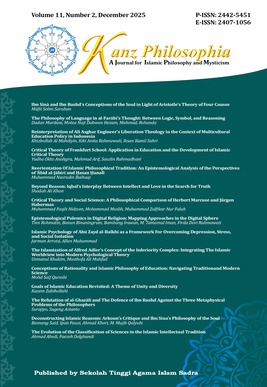
IQBAL’S INTERPLAY BETWEEN INTELLECT AND LOVE IN THE SEARCH FOR TRUTH
DOI:
https://doi.org/10.20871/kpjipm.v11i2.424Keywords:
Intellect, Love, Muhammad Iqbal, Ultimate RealityAbstract
This paper delves into the profound and intricate relationship between Love (ishq) and Intellect (aql) within the philosophy of Muhammad Iqbal, a visionary poet and philosopher, aiming to reveal how these two forces shape the development of the human self (khudi) and contribute to the realization of spiritual and moral freedom. According to Iqbal, while intelligence is useful for getting to know things and thinking critically, love goes beyond reasoning and provides the spiritual and emotional depth needed to have a closer relationship with God. While both intellect and love are essential faculties of the human experience, Iqbal frames them as complementary forces in a dynamic relationship, where intellect is analytical, cautious, and calculating, whereas love is intuitive, passionate, and self-transcendent. The main motto of this research is to show how Iqbal emphasizes the primacy of love in the process of spiritual awakening, while affirming that both faculties work in tandem, without negating reason, but asserting that reason alone cannot lead to spiritual awakening or transformative action. For Iqbal, it is ishq that fuels the soul’s courage, sacrifice, and divine connection, ultimately leading to the strengthening of khudi. Through a comparative and analytical approach, the study highlights Iqbal’s integration of classical Islamic thought with modern existential concerns, demonstrating how love becomes a cosmic principle, whereas intellect remains a useful yet limited tool. In conclusion, this research asserts that true selfhood and moral leadership emerge not from intellect alone but rather through a harmonized interplay in which love leads, and intellect follows. This equilibrium lies at the heart of Iqbal’s vision for the revival of humanity.
Downloads
References
Akbar, Rizamul Malik, and Achmad Khudori Soleh. 2025. “The Classification of Knowledge Based on Al-Ghazali’s Perspective and Its Relevance to Qur’anic Exegesis.” FiTUA: Jurnal Studi Islam 6 (2): 218–28. https://doi.org/10.47625/fitua.v6i2.1066.
Alhaq, Shuja. 1997. Forgotten Vision: A study of Human Spirituality in the lights of Islamic Tradition. New Delhi: Vikas Publication House, Pvt. Ltd.
Ali, Sheikh Akbar. 1988. Iqbal: His Poetry and Message. New Delhi: Deep and Deep Publications.
Aman, Rifat. 2017. “Iqbal’s Theory of Knowledge.” International Journal of Humanities and Social Sciences Research 3 (5): 42–44.
Amin, Muhammad. 2009. Muslim Epistemology: An Analytical Appraisal of Islamization of Knowledge. Pakistan: Safa Educational Reforms Trust.
Amir, Ahmad Nabil, and Tasnim Abdul Rahman. 2024. “The Role of Muhammad Iqbal in Islamic Thought.” Indonesian Journal of Islamic Theology and Philosophy 6 (2): 155–78. https://doi.org/10.24042/ijitp.v6i2.24287.
Ansari, Asloob Ahmad. 1978. Iqbal: Essays and Studies. New Delhi: Ghalib Academy.
Begum, Shagufta. 2013. “Iqbal’s Epistemology.” International Journal of Humanities and Social Science 3 (12): 145–53.
Bhat, Abdul Rashid. 2017. “Muslim Response to Modern Western Knowledge: An Approach to Allama Iqbal’s Views on Knowledge.” Insight Islamicus 17: 15–32.
Enver, Ishrat Hassan. 1944. Metaphysics of Iqbal. Lahore: SH. Muhammad Ashraf, Kashmiri Bazaar.
De Diego González, Antonio. 2023. “The Challenge of Muhammad Iqbal’s Philosophy of Khudi to Ibn ‘Arabi’s Metaphysical Anthropology.” Religions 14 (5): 683. https://doi.org/10.3390/rel14050683.
Haidar, Syed Sajjad. 2021. “The Connection Between Reason and Intuition in the Thought of Muhammad Iqbal.” SAJRP 2 (1): 57–70.
Haluti, Rahmat, and Munirah Munirah. 2022. “Epistemology of Muhammad Iqbal’s Existentialism: Its Levation to Islamic Education.” Pekerti: Journal Pendidikan Islam Dan Budi Pekerti 4 (2): 83–97. https://doi.org/10.58194/pekerti.v4i2.3293.
Hasanah, Nurul, Yosi Nofa, and Roni Pasaleron. 2025. “Reconstruction of Islamic Thought in the Perspective of Muhammad Iqbal.” Journal of Islamic Thought, Research and Practice 1 (1): 10–17. https://doi.org/10.70588/jitera.v1i1.512.
Hasib, Kholili, Amal Fathullah Zarkasyi, and Muhammad Khalid Muslih. 2024. “Intuition According to Imam Al-Ghazali and It’s Role as Methods of Acquiring Knowledge.” Kalam 18 (1): 81–106. https://doi.org/10.24042/002024181880100.
Hidayat, Alfan, and Johan Alamsah. 2024. “Muhammad Iqbal’s Philosophy of Khudi (A Critical Analysis of Modern Science).” Indonesian Journal of Islamic Theology and Philosophy 6 (1): 19–42. https://doi.org/10.24042/ijitp.v6i1.20742.
Husni, Amin Said, Moh Syaeful Bahar, and Dodik Harnadi. 2025. “Purifying the Heart, Unveiling the Truth: Understanding Al-Ghazālī’s Epistemology.” Journal of Pesantren and Diniyah Studies 2 (1): 1–14. https://doi.org/10.63245/jpds.v2i1.32.
Iqbal, Muhammad, S. 1962. Zabur-i-Ajam. Delhi: Kutub Khana.
———. 2005. Bal-e-Jibril. Delhi: Aeteqad Publishing House.
———. Iqbal, Muhammad. 2018. The Reconstruction of Religious Thought in Islam. New Delhi: Kitab Bhavan.
Ja’far, Suhermanto. 2015. “Epistemologi Tindakan Muhammad Iqbal.” Teosofi: Jurnal Tasawuf dan Pemikiran Islam 5 (1): 80–106. https://doi.org/10.15642/teosofi.2015.5.1.80-106.
Jannataini, Zahira, Jamali Jamali, and Sumanta Sumanta. 2025. “Philosophical Foundation of Islamic Education in Muhammad Iqbal’s Asrar-i Khudi: An Ontological, Epistemological, and Axiological Analysis.” Jurnal Fuaduna: Jurnal Kajian Keagamaan dan Kemasyarakatan 9 (1): 83–99. https://doi.org/10.30983/fuaduna.v9i1.9434.
Kartawinata, Ali. 2016. “Konsep Metafisika Muhammad Iqbal.” Al-A’raf: Jurnal Pemikiran Islam dan Filsafat 13 (1): 47–64. https://doi.org/10.22515/ajpif.v13i1.37.
Khan, Zain, and Sourath Seelro. 2025. “Integrating Iqbal’s Concept of Sensory Perception and Intuition in Contemporary Pakistani University Classrooms.” Payam-i-Iqbal Bahria Research Journal on Iqbal Studies 4 (2): 1–15.
Khān, Ghulām ‘Umar. 1964. Iqbal Kā Taṣavvur-i ‘Ishq. Ḥaydarābād: Rafīq Mashīn Pres.
Khatoon, Jamila. 1997. The Place of God, Man and Universe in the Philosophic System of Iqbal. Lahore: Iqbal Academy.
Khan, Tarique, and Mudasir Tantray. 2021. Concepts in Muslim Philosophy. Bilaspur: Rudra Publication.
Masruri, Muhammad Muhammad. 2020. “Konsep Khudi Iqbal dalam Pengembangan Kreatifitas Pembelajaran di Madrasah.” Jurnal Penelitian Keislaman 16 (1): 46–59. https://doi.org/10.20414/jpk.v16i1.2220.
Mubeen, Khalid. 2011. “Allama Iqbal k Tasawur-e Ishq.” Iqbal 57/58 (1–4): 49–59.
Mutlag, Abdulkadhim Hashim. 2022. “Sufism and the Philosophy of Love in Rumi’s Doctrine.” Res Militaris: European Journal of Military Studies 12 (1): 53–58.
Nafiudin, Muhammad Aviv. 2024. “Konstruksi Cinta Ilahi Jalaluddin Rumi.” Jurnal Ilmiah Spiritualis: Jurnal Pemikiran Islam dan Tasawuf 10 (1): 1–19. https://doi.org/10.53429/spiritualis.v10i1.864.
Popp, Stephan. 2019. “Muhammad Iqbal – Reconstructing Islam along Occidental Lines of Thought.” Interdisciplinary Journal for Religion and Transformation in Contemporary Society 5 (1): 201–29. https://doi.org/10.30965/23642807-00501011.
Qaiser, Nazir. 1989. Rumi’s Impact on Iqbal’s Religious Thought. Lahore: Iqbal Academy.
Qizi, Orazmatova Mahliyo Dilmurod. 2025. “Philosophy of Love and Spiritual Perfection in The Poetry of Jalaluddin Rumi.” International Journal of European Research Output 4 (2): 317–26.
Roswantoro, Alim. 2017. “The Philosophical Study of Iqbal’s Thought: The Mystical Experience and the Negation of The Self-Negating Quietism.” Teosofia: Indonesian Journal of Islamic Mysticism 6 (1): 1–20. https://doi.org/10.21580/tos.v6i1.1698.
Rozi, Achmad Bahrur. 2021. “Hierarki Ilmu Pengetahuan Al-Ghazali: Suatu Tinjauan Filosofis.” Tafhim Al-’Ilmi 12 (2): 202–24. https://doi.org/10.37459/tafhim.v12i2.4453.
Shadiqin, Sehat Ihsan, M. Agus Wahyudi, Alfiatunnur Alfiatunnur, and Shabrun Jamil. 2024. “Rumi Concept of Love: The Path to Interfaith Harmony and Peace.” Al-Albab 13 (2): 157–73. https://doi.org/10.24260/alalbab.v13i2.2986.
Umaruddin, Muhammad. 2008. The Ethical Philosophy of Al-Ghazali. Lahore: Institute of Islamic Culture.
Yasrif, M. Ali, and Jarman Arroisi. 2025. “Teori Khudi Perspektif Muhammad Iqbal: Analisa Terapi Holistik Mengatasi Obsessive Compulsive Disorder.” Al-Hikmah: Jurnal Agama dan Ilmu Pengetahuan 22 (1): 116–30. https://doi.org/10.25299/ajaip.2025.vol22(1).18894.
Zinira, Maurisa. 2016. “Adab for A Peaceful World: A Study of Jalaluddin Rumi’s Concept of Sufism.” Teosofia: Indonesian Journal of Islamic Mysticism 5 (2): 67–80. https://doi.org/10.21580/tos.v5i2.1714.
Downloads
Published
How to Cite
Issue
Section
License
Copyright (c) 2025 Shadab Ali Khan

This work is licensed under a Creative Commons Attribution 4.0 International License.


Journal Tools


Evaluation Progress Scopus

Article Template

Google Scholar Citations

Sinta

CITEDNESS IN SCOPUS

Current Issue


Information
MAPS